What is Matcha??
Finely ground powdered green tea that originated in China but became a staple of Japanese tea culture. It is cultivated from shade-grown tea plants known as Camellia Sinensis.The meticulous production process achieves the distinctive, vibrant green colour and rich, umami flavour of this tea. The farmers shade the tea plants from sunlight for about 20-30 days before harvesting. This boosts chlorophyll production and enhances the amino acid content. The handpicked leaves are then carefully steamed to halt fermentation, dried, and stone-ground into a fine powder.
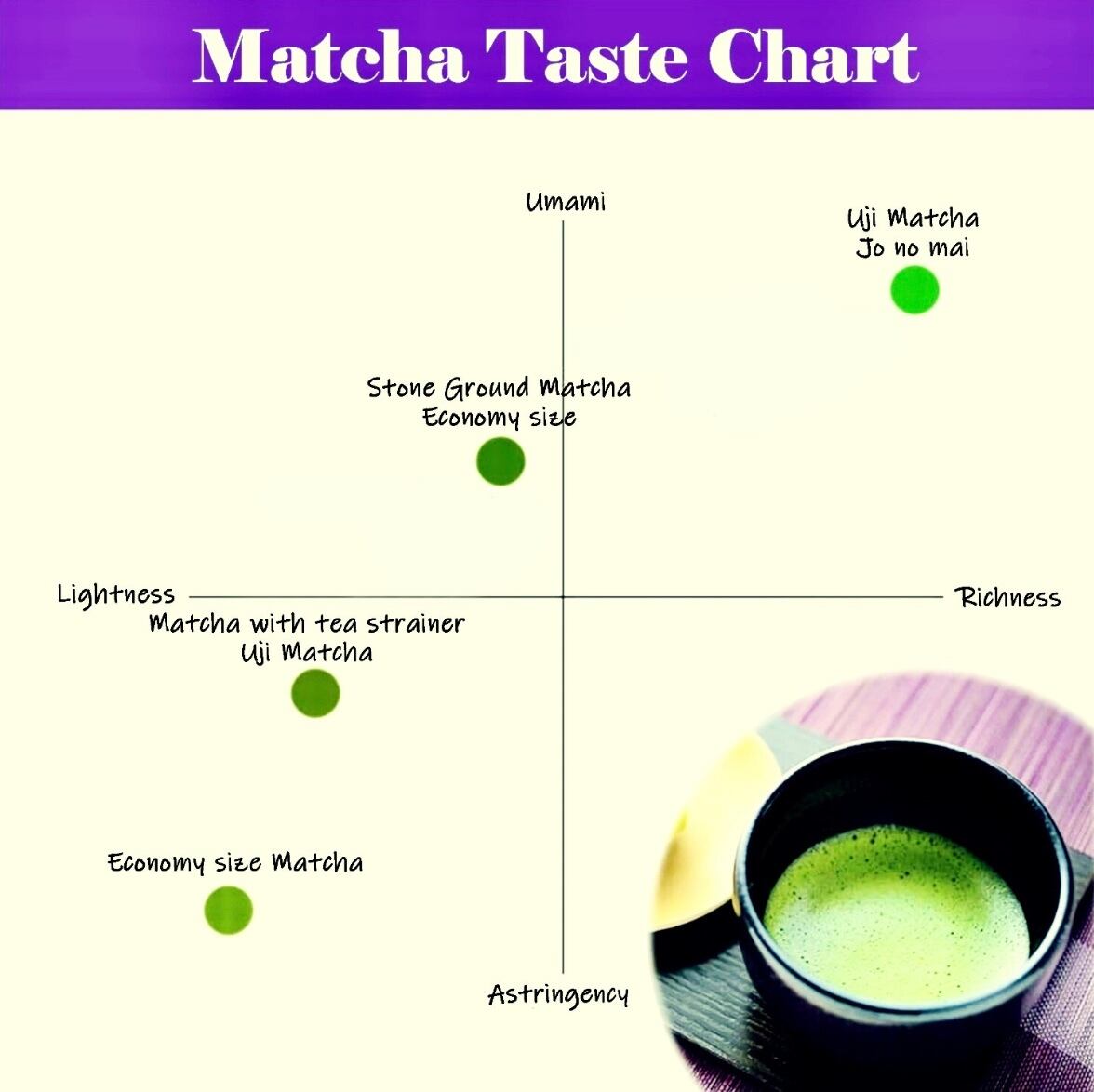
Here is the Matcha Taste Chart of our
products! Please refer to this when
purchasing the products!!
Uji Matcha (宇治抹茶)
Before featuring Uji Matcha, we would like to mention where famously Matcha is produced.
Where Matcha is grown?
Matcha is grown in a few regions of Japan, but mainly in the south of the country. Tea is a lot like other geographically specific beverages (say, wine). This just means that the growing locations of tea plants matter a lot. This concept is called terroir, which refers to the microclimate or a specific location and how light, water, soil, and all other growing conditions come together to create and impact flavor.
So naturally, some areas will be more suited for growing a specific plant, which is absolutely the case for tea. Below are the main growing locations for matcha. Some of which are known for producing higher quality and better tasting teas than others.
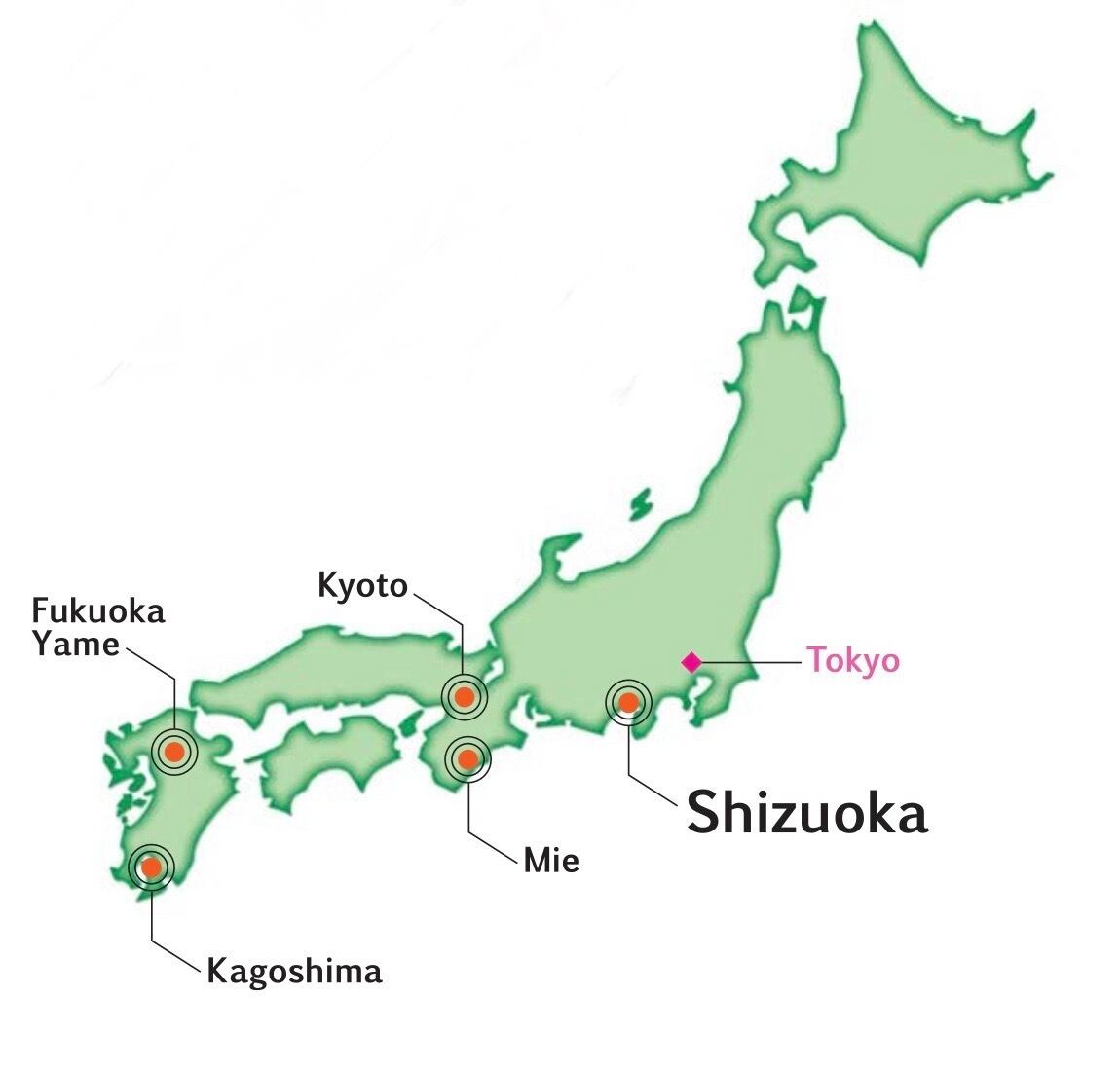
1. Uji Matcha, 宇治抹茶 (Kyoto)
2. Shizuoka Matcha, 静岡抹茶 (Shizuoka)
3. Yame Matcha, 八女抹茶 (Fukuoka)
4. Ise Matcha, 伊勢抹茶 (Mie)
5. Kagoshima Matcha, 鹿児島抹茶 (Kagoshima)
☑︎ UJI MATCHA
Uji is a region in Kyoto Japan. It’s known for producing some of the most prestigious Matcha in the country and has a long legacy. Uji is a fairly small region, and can only produce a relatively small amount of tea meaning it can be pretty expensive.
Matcha from Uji is known for having oceanic, nori notes and can be some of the most sought-after Matcha on the planet. Within Uji, there are smaller micro-terroirs that have varying degrees of reputation.
☑︎ SHIZUOKA MATCHA
Shizuoka is the prefecture that’s home to Mount Fuji, Japan’s highest peak. Shizuoka is the largest tea-producing prefecture in Japan. It produces around 40% of all Japanese tea. Most of that is loose leaf green tea such as Sencha, but because of increased international demand includes producing some matcha.
☑︎ YAME MATCHA
Fukuoka is a prefecture in Kyushu, which is on the southwest end of Japan and the mountains of Fukuoka are the first place tea was grown in Japan! One of the most famous teas growing regions in Fukuoka is Yame. (Which is located in the North of the prefecture.) The teas grown there are usually processed as high-end loose leaf green teas such as Sencha and Gyokuro (not as matcha) - but you can find some Matcha in the region.
☑︎ ISE MATCHA
Mie matcha (Ise matcha) is made from tea leaves cultivated in a warm climate with abundant rainfall. It is characterized by its rich umami and sweetness, offering a smooth and mellow taste. Additionally, it is known for its fragrant aroma and silky texture.
☑︎ KAGOSHIMA MATCHA
Kagoshima has rich volcanic soil and this makes for great tea growing. They’re mainly known for their loose-leaf sencha tea. But some matcha is produced there.
The culture and history of Uji Matcha
The cultivation of tea in Uji is said to have its origins at the beginning of the 13th century, during the Kamakura Period. Blessed with good soil quality and topography, among other favorable conditions, tea cultivation in Uji rapidly expanded.
The custom of tea drinking began to spread during the mid-1400s. Uji tea was considered a first-class gift, and the tea-guessing game “Tocha” was created.
Eventually, tea drinking and cuisine were combined. “Cha no Yu,” tea ceremony prizing tea ceremony tools and sitting room ornamentation, was developed and was spread through Japan by merchants and others.
In the 15th century, Uji became as big a tea producer as the famed Toganoo in Kyoto. The tea plantation “Oku no Yama,” one of Uji’s “Seven Famous Gardens”, was founded during the Muromachi Period, and is still present in Uji today.
A new method of tea cultivation called “?ishita Saibai” was developed in Uji in the latter half of the 16th century. This method produced tea with vivid, dark green leaves and a strong flavor. It earned the value of best in Japan, and it is said that this tea was used to produce the first batch of matcha, Japan’s famous powdered green tea.
This matcha was essential to Sen no Riky?’s successful “Cha no Yu”, and so he had sought those quality improvements. The setting of tea ceremony, the tea room, was built as a place where guests were entertained with tea and food. The Taian tea room in Myokian Temple (?yamazaki Town, Kyoto), attributed to Sen no Riky?, and tea rooms and plantains of his Three Senke Tea Schools (The Omote-Senke School, The Ura-Senke School, and The Mushakoji-Senke School) still considered very culturally significant properties.
At the beginning of the 17th century, 3rd Shogunate Tokugawa Iemitsu commanded the Kanbayashi family of Uji to create high quality tea for both presentation to the court and for the Shogun’s personal use. He then institutionalized the “Chatsubo-Dochu” (lit. “Tea Pot Journey”) to deliver new tea to Edo (present-day Tokyo). This road was in commission for 250 years. As the principal leaders of the Chatsubo-Dochu, the tea masters of Uji continued supporting the culture of Japanese tea for a long time. The homes and workshops of these tea masters are still lined up on Uji Bashidori in Uji City, evoking a feeling of times past.
At the start of the 17th century, as Japan passed into the Edo Period, Monk Ingen of Manpuku-ji Temple spread kamairi , the “roast and roll” method of tea preparation, throughout Japan. Halfway through the Edo Period (around the mid-18th century), Nagatani S?en of Uji’s Tawara-Yuyatani area created The Uji Method (Uji Sehou, also known as Aoseisenchahou). This groundbreaking method of tea preparation involved crumple-drying boiled tea buds over a dedicated tea-drying furnace.
Tea produced with this method was first sold in only in Edo, where it sold well and became quite popular. Afterwards, it earned a favorable reception in all other areas of Japan, and the Uji Method’s use spread throughout other tea-producing areas. Even today, the Uji Method is the main method used in Japan.
Furthermore, at the end of the Edo Period, “gyokuro” (high quality green tea) was created in Uji by using the Uji Method to prepare tea grown in the Oishita Saibai method. Drinking gyokuro and sencha (middle-grade tea) at tea parties spread among the cultured in Kyoto, and tea ceremony rooms that used sencha exclusively were created.
From the last days of the Tokugawa Shogunate to the beginning of the Meiji Period (around the early 19th century), Uji tea became a major part of Japan’s export industry, and work began on a supply of high quality tea specifically for trade. Land in the Yamashiro area of Kyoto, including Wazuka Town and Minami Yamashiro Village, was cleared for tea cultivation. One can see many outstanding tea plantations in this area, now called “Yamanari Kaikon.”
In the second half of the Meiji Period, a national market for Uji tea was created, and through mail-order purchasing, tea became an integral part of the lives of ordinary households. In addition, making the best use of its peerless processing and blending techniques, multiple high-quality teas were developed. The reputation of Uji tea was decided.